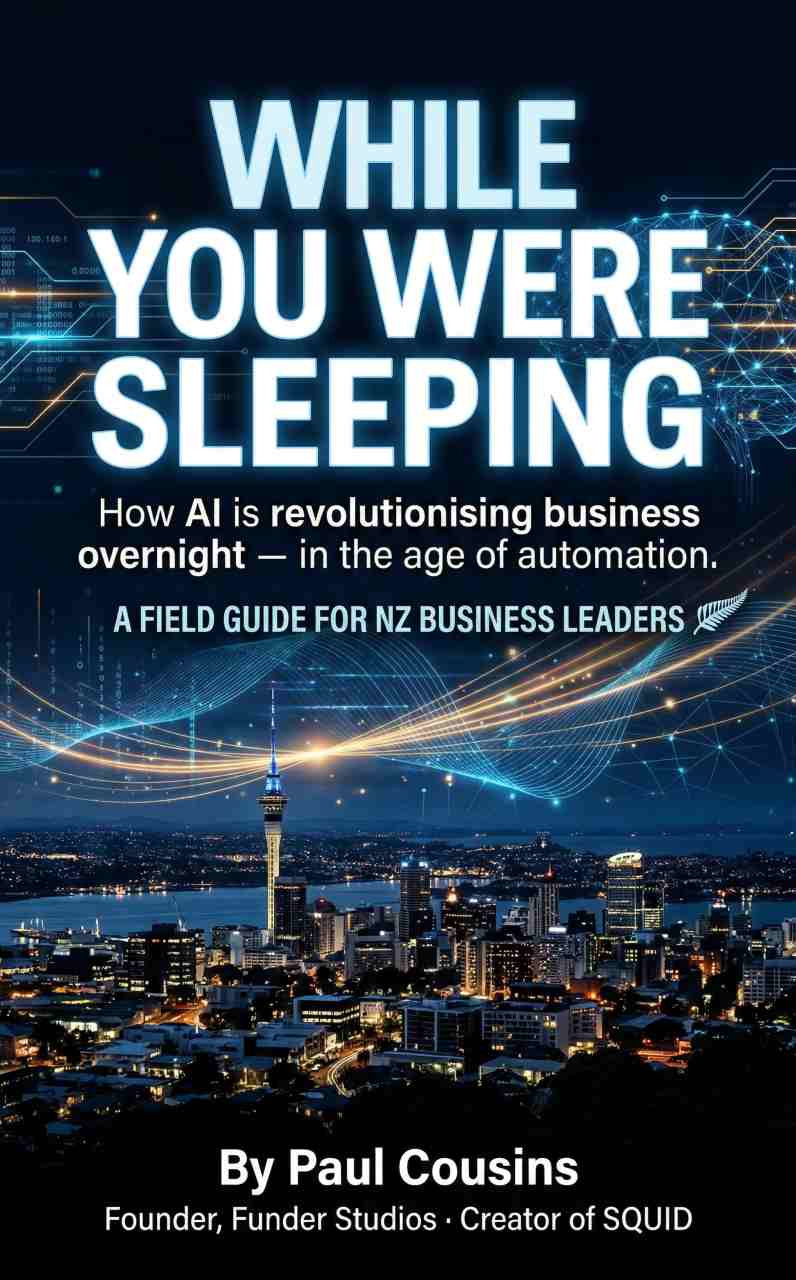
While You Were Sleeping
How AI is revolutionising business overnight — in the age of automation.
The Great Consolidation
It's 2010. And I'm selling iPhones to Vodafone.
Not on the shop floor — I was the wholesale sales agent they bought their stock from. I oversaw their entire Apple inventory, managed their online store sales, and I was there for one of the most significant technology deployments ever made in New Zealand: 150 million dollars worth of iPhones deployed to the NZ Police Force, effectively digitising and mobilising an entire national workforce overnight.
What I was watching wasn't a phone launch. It was a consolidation event. A camera, a map, a calendar, a music player, a bank, a torch, a police radio — collapsing into a single device in your pocket. The companies making standalone GPS units? Gone. Point-and-shoot cameras? Gutted. The world reorganised itself around a new centre of gravity, and most people didn't see it coming.
"The consolidation wasn't coming. It was already happening. Most people just couldn't see it yet — and that's exactly what's happening with AI right now."
A few years later I was managing a $90 million annual portfolio at Ingram Micro — working with enterprise clients running Oracle, Salesforce, SAP. Companies spending millions on tools that were supposed to solve everything.
They didn't. Every manager, every operations lead, every CEO I sat with had the same complaint: "I just need one place where I can see what's actually happening in my business."
The software was designed by engineers, for engineers. Not for the sales manager who needed to hit KPIs by Friday. The conflict between what IT built and what real people needed was baked into every product, every organisation, every missed report.
Working in the smart farming sector at Datamars, I heard it again — louder. Farmers are running complex, high-stakes operations. Every cow has an RFID tag. Automated gate systems have APIs talking to rotary milkers, talking to scales, talking to feed systems — each one screaming for your attention, each one reporting only on its own little slice of the farm.
They had more data than any previous generation of farmer. And it was completely overwhelming. Every single farmer told me the same thing:
"I've got too many systems. I need a single pane of glass."
I could see the solution. The market couldn't yet. So I kept building. Kept watching. Then AI arrived — and everything changed overnight.
The Day I Deleted Everything
It happened on a Tuesday. I remember it clearly.
I'd been running my business on a patchwork of tools for years. Trello for tasks — that checklist was basically my entire business brain. Google Calendar for scheduling. Google Drive for documents. Google Analytics for traffic. Adobe Cloud. Canva. Three different CRMs. Slack. A project management tool I half-used. Calendly. Various subscriptions draining quietly in the background, month after month.
In one session, I built my own version of all of it. A single dashboard. My tasks, my clients, my analytics, my campaigns — one screen, designed exactly the way I think, reporting exactly what I needed.
"That same day, I cancelled six SaaS subscriptions. And I realised — this is what's about to happen to every business on earth."
They knew it was happening. They just couldn't fix it.
The AI insight from the farm sector crystallised it. I saw AI APIs emerging and realised: we can now take big, messy, overwhelming data — the kind that defeats humans and spreadsheets — and turn it into clear, actionable intelligence. A cow with a fitbit generates thousands of data points. Which ones predict disease three days early? Which ones signal a paddock rotation problem? A human can't process it. A basic algorithm gives you a report. AI gives you the answer.
I tried to push the companies I worked with to move faster. They couldn't. Big software moves slowly — designed to serve millions of users, not one business. That's the fundamental problem. And it's exactly why this moment is your opportunity.
What AI Actually Is
(Plain English)
Let's kill the jargon right now.
AI is not a robot. It's not Terminator. It is, at its core, a very fast, very capable pattern-recognition engine that can read, analyse, write, decide, and automate — at a scale no human team can match.
"You don't need to understand how AI works. You need to understand what it can do for your bottom line."
- Your data finally works for you. All those spreadsheets, reports, and disconnected systems? AI reads all of them simultaneously and tells you what actually matters.
- Your admin gets automated. Follow-up emails, reminders, reports, summaries — things your team spends hours on — happen automatically, without human input.
- You stop relying on memory and gut feel. Every client interaction, every decision, every dollar is captured, tracked, and surfaced when you need it.
- You stop paying for 12 tools. One bespoke system replaces your stack — built exactly for how your business works, not how some Silicon Valley engineer imagined it.
- You make better decisions, faster. Instead of waiting for a weekly report that's already out of date, you have live intelligence at your fingertips.
The reason this wasn't possible five years ago is simple: building custom software required a team of programmers, six months of development, and a six-figure budget. AI has collapsed that equation completely. Development time is days, not months. Cost is a fraction of what it was.
Moore's Law — the same force that put a supercomputer in your pocket in 2010 — is now putting enterprise-grade business intelligence within reach of any business, any size.
The $300,000 Blind Spot
I want to tell you about a conversation that stopped a CEO in his tracks.
Well-run NZ organisation. Good team. A leader who genuinely cared about doing things right. He knew the organisation was losing significant revenue — it was an accepted reality, a frustrating known unknown. The data to solve it existed. He just couldn't get to it. The problem was too big, too complex, too many moving parts for any human team to reconcile across multiple systems.
For AI? It was rudimentary.
When we connected his systems and ran the analysis, the number that came back was over $300,000 a year in recoverable revenue. He shifted in his seat — not in shock, but in recognition. He'd known something was wrong. Now he could finally see it. And more importantly: now he could fix it.
"The data existed. The problem existed. The fix existed. The only thing missing was the tool to connect them — and that's exactly what we built."
Revenue leakage isn't caused by incompetence. It's caused by complexity. When you have multiple systems each reporting on their own slice of the business — and nothing connecting the whole picture — you have gaps. And gaps cost money. The human brain simply cannot hold months of data from multiple systems in its head simultaneously and calculate the intersections.
AI can. In seconds.
| Without SQUID | With SQUID |
|---|---|
| Multiple disconnected systems | One unified dashboard |
| Weekly manual reports | Live real-time intelligence |
| Accepted revenue leakage | Gaps identified and closed |
| Decisions based on gut feel | Decisions backed by data |
| $300K+ lost every year | Revenue recovered and growing |
Meet SQUID:
Your AI Stack
SQUID is not another SaaS subscription. It's yours.
SQUID — System for Quantified Unified Intelligence and Data — is a bespoke AI business platform built specifically for your business. Not a template. Not a one-size-fits-all tool. A custom-built engine that integrates your existing systems, surfaces your most important data, and automates the work your team shouldn't be doing manually.
- 01 — Discover. 30 minutes. We understand your business — your systems, your pain points, where the money is going. No jargon, no IT team required. Just a straight conversation with Paul.
- 02 — Build. We design and deploy your custom SQUID dashboard. Your data sources connected. Your workflows automated. Your KPIs visible in real time. Fixed cost. Fixed timeline.
- 03 — Own. You own the system. No ongoing licence fees to us. No vendor lock-in. No waiting two years for a report someone promised. You control it. We support it.
Most businesses are paying monthly for a stack of tools that don't talk to each other properly. SQUID consolidates or connects them into a single view. Typical replacements include: project management tools, CRM systems, manual reporting processes, disconnected analytics, booking and calendar systems, and manual follow-up workflows.
"Own your AI stack instead of renting SaaS forever. The tools you're paying for monthly were designed for someone else's business. SQUID is designed for yours."
What Does This
Actually Cost?
Let's be straight about the money.
We charge for outcomes, not time. Every engagement is a fixed-cost scope of work — you know what you're getting and what you're paying before we start. No surprises. No hourly invoices. No scope creep conversations.
| Stage | What You Get | Investment |
|---|---|---|
| Discovery | System audit, pain point mapping, solution design — a structured deep-dive into your business. | $1,000 + GST |
| Stage 1 | Core dashboard with manual data ingestion — drag in your Excel data, get live reporting instantly. | From $5,000 |
| Stage 2+ | Full AI automation, API integrations, live data feeds, advanced intelligence modules. | From $10,000 |
To put it in perspective: if we identify even $50,000 in annual leakage — and in our first client engagement we found six times that — a Stage 1 SQUID implementation pays for itself within weeks, not years.
"We are so fast we can't charge for time anymore. We charge for outcomes."
Your AI Journey Starts With One Conversation
You've read this far. That tells me something.
You're not someone who ignores the signals. You know the problem — you've probably lived with it for years. The data exists, the cost is real, you just haven't had the right tool to fix it. That's exactly what SQUID does.
A 30-minute conversation with me isn't a sales pitch. It's a straight conversation about your business, your systems, and where the biggest opportunities are hiding. I've spent 20+ years sitting across from business leaders — Apple, Vodafone, enterprise IT, smart farming — watching the same patterns repeat. I built SQUID because I got tired of watching NZ businesses lose money to problems AI can solve in days.
"The best time to start was 12 months ago. The second best time is right now — before your competitor does."
Just want to ask a quick question first? Email us anything: [email protected]
Book a free 30-minute discovery session. No jargon. No pressure.
Just a straight conversation about your business.